IRIS project – Visit to the Rutherford Appleton Laboratories (RAL), Oxford
A small group of Year 12 students has been participating in a challenging research project called the Big Data: ATLAS. The ATLAS detector is used by physicists to observe the results of proton-proton collisions in the Large Hadron Collider at CERN in Geneva, the largest collider of its type in the world.
Big Data: ATLAS introduces students to the techniques used to analyse ATLAS data, giving them the chance to explore their own questions in particle physics. Students learn analytical and coding methods used by particle physicists. They develop critical skills in statistical analysis, Python computer programming, data presentation and interpretation of ATLAS open-source data, including how to find evidence of the Higgs boson.
As part of the project, we were able to visit the Rutherford Appleton Laboratories (RAL), Oxford. After a train, tube and train journey, we arrived on the local bus. This was the perfect way to truly appreciate the size and scale of the research facilities and was so inspiring. The regular security patrols within the research park highlighted the important nature of the research. The day began with an excellent lecture on particle physics and our students then got the opportunity to tour one of the ten supercomputer storage buildings needed to house the vast amounts of data produced, wearing ear defenders and seeing how they keep it cool.
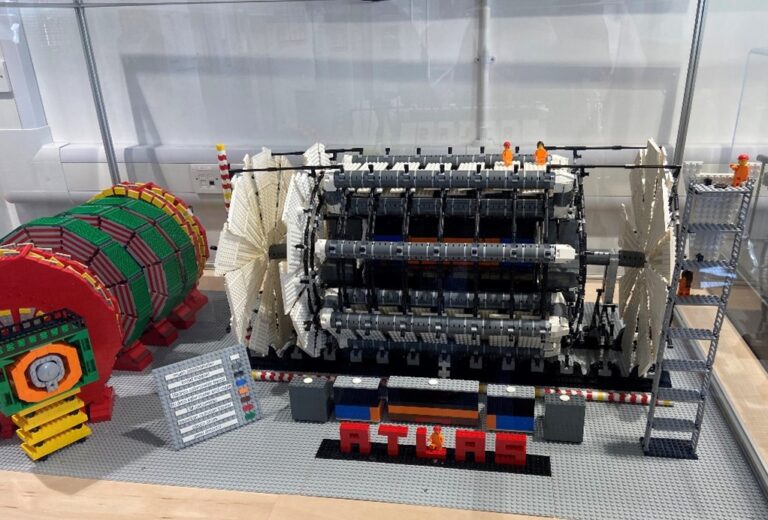
We saw equipment used in the search for dark matter and neutrinos. A particular favourite was the scale model of the ATLAS collider constructed out of Lego.
The afternoon was dedicated to continuing with their research project, supported by particle physicists. The day ended with a careers panel, showcasing the variety of jobs and pathways that had led the physicists to work at RAL. Our students were able to ask questions throughout the day and found it incredibly useful to see the opportunities available to them. They are now beginning to produce a scientific poster of their research to display at the annual IRIS Conference in London.